Woodworking Plans Banner
Bedroom etiketine sahip kayıtlar gösteriliyor. Tüm kayıtları göster

20 Mart 2015 Cuma

Tile Top Plant Stand Plans

Free woodworking plans to build an inexpensive plant stand with a tile top.

I decided to add more plants to my home without first thinking about where to put them! So I came up with this simple yet attractive design for DIY plant stand that's easy to build. You can even build it with minimal tools or get the wood cut for you at the store. You can build one for as little as $8 or if you're building 3 of them the cost comes down to around $6 each depending on the wood you choose.
Read more »

9 Şubat 2013 Cumartesi

Easy Small Closet Organizer Plans

Free woodworking plans for a reach in closet organizer that provides double hang, long hang, shoe and sweater shelves for a small closet.

My previous small closet organizer design provided a lot of storage for a narrow closet but it may be a little too complex for some to build. This new design is easier and cheaper to build. If you use MDF you can organize your closet for around $50. It doesn't provide as much shelf storage but it still has plenty of double hang as well as long hanging space and shelves for shoes and sweaters. With a closet this small you're going to need a dresser to store folded clothes anyway so that much shelving isn't as important.

If your current closet only has a typical single rod and single shelf you can see how much space gets wasted. With a little bit of wood and a few hours of time you can dramatically increase the space utilization of your closet. If you've been dealing with a small  3'-4' closet you know how important it is to squeeze as much extra storage as possible.

Good shoes are expensive and just tossing them on your closet floor increases the likelihood they get damaged. Shoe shelves help protect the investment you've made in your shoes.

Providing space for long garments is also important and this organizer allows you room to hang up some of those long dresses or coats so you don't have to run to another room for them.

The Right Hangers Save Space
I've designed the storage unit so that the interior shelves are 14" wide. That will hold folded clothing comfortably as well as 2 pairs of womens shoes side by side or one pair of mens shoes on each shelf. If you want less shelving space and more hanging space you can choose to make the shelving unit narrower (or wider for more shelvnig less hanging).

You can customize the dimensions of these plans to better suit your needs just keep in mind these general guidelines. The shelving unit needs to be 42" tall to be able to hold the double hanging rod. Women's shoes generally need about 7" of width, mens shoes 9" and sweaters and other folded clothing 12". Every body is different so measure how much space your clothes take and see if you need to customize the plan to get more efficient use.

What You'll Need

Materials

Tools

Cut List

  • (5) ~12" x 14" Shelves 3/4" Plywood
  • (2) ~12" x 9" Shoe Shelves 3/4" Plywood
  • (2) ~12" x 42" Shelving Unit Sides 3/4" Plywood (See Cut Plan for exact shape)
  • (1) 24" Rod Support 1x4 Board (or whatever the depth of your closet is)
  • (2) 14" Stretchers  1x4 Board
  • (2) 18" Shoe Shelf Supports 1x2 Board 

Cut Plan

3/4" Plywood

The first quarter sheet of 3/4" plywood will be for the shelves. You may want to alter the number and width of the shoe shelves depending on your design. The depth will be slightly less than 12" because of the kerf of the saw. Do your best to cut it as evenly down the middle as possible.
The second sheet is where we'll cut the sides for the shelving unit. To be able to limit the amount of plywood necessary the cuts aren't simple straight cuts. Again, the depth at the middle will be a little less than 12" due to the saw kerf. It's probably best to cut this out with a jig saw.

Boards

1x4: Two lengths of 1x4 need to be cut to the same width as the shelves, in our case 14" and one length that is determined by the depth of your closet for the lower rod support on the side wall.

1x2: One shoe support needs to be cut from 1x2 material for each side shoe shelf. The support needs to be long enough to reach from the back corner of the closet to at least the first side wall stud so that it is screwed securely at each end.

Step 1: Cut Lumber and Finishing

To minimize the time that the closet is out of service we're going to build much of the closet organizer before installing it. This includes finishing the wood so that it's dry when it's installation time. If you don't have a lot of space to lay all the plywood out flat to paint, you might find it easier to paint after you've assembled the shelving unit or just paint everything after installing but you'll have to wait until it dries before using the closet.

Double check your closet measurements and make any modification you need to the cut plan if you choose to customize the size based on your needs.

So that we can get 2 sides out of one 2' x 4' sheet of plywood they're not cut straight. Start off by cutting the board down to 42" in length. If you're comfortable making plunge cuts with a circular saw it's the best way to cut the horizontal cuts. The vertical cuts and rounded corners are best cut with a jig saw. You can also use a jig saw to make the entire cut just take your time and use a straightedge to get the cuts as straight as possible on the long stretches.

You may also want to increase the 4" to 6" or so for a little extra flexibility in positioning the lower rod.


Once you have the 2 sides cut out, a notch will need to be cut out at the back bottom of each side to fit around your baseboards.

Once everything is cut, prime and apply two coats of water based paint. Let everything dry at least 2 days before continuing. Let the paint cure for at least a week (more if weather is humid) before placing items on the painted surfaces.

Step 2: Attach Top to Side

The shelving unit consists of 2 sides, 2 stretchers and 2 fixed shelves. We're going to begin constructing it by attaching the fixed top to one side using pocket hole screws from underneath.


Note that the back of the top is flush with the back of the side and the notch cut out in the back/bottom of the side for the baseboard so it will fit close up against the wall. The front of the top does not extend all the way to the front of the shelving side.

Step 3: Attach Bottom Shelf To Side

Next we'll attach the bottom to the side. The shelving unit needs 2 fixed shelves to make it sturdy. The location of the top shelf needs to be at the top but you have some flexibility when positioning the bottom shelf.

I've planned for the bottom of the bottom shelf to be 12-1/2" from the bottom of the side but depending how big the items you plan to store in that area are, you might want to increase or decrease it. For example, if you want to store boots you may want to increase it.

Make sure the side is square to the front of the side and attach it using pocket hole screws as you did the top.

Step 4: Attach Stretchers To Side

Two stretchers cut from 1x4 boards are used to provide a way to attach the shelving unit to the wall as well as provide extra strength. Using pocket screws attach them to the side and fixed shelves as shown.


The bottom stretcher needs to clear the baseboard notch. If you want the shelf lower, mount the stretcher above the bottom shelf instead of below it.

Step 6: Attach Other Side

Finally we'll attach the other side of the shelving unit using the previously drilled pocket holes in the fixed shelves and stretchers. It's important that everything gets screwed together square.

Step 7: Drill Shelf Pin Holes

With the shelving unit completed we can now drill 2 rows of shelf pin holes on each side of the shelving unit. This is much easier to do with a jig like the Kreg Shelf Pin Drilling Jig.

For each set of holes use the same reference point. For example start all sets of holes by resting the bottom of the jig against the bottom shelf.

If you don't have a pocket hole jig you can either screw the shelves in directly using pocket hole scres or you can manually mark and drill the holes for the shelf pins. 1-1/4" spacing 2" from the front and back should do it.

Step 8: Move Existing Rod and Shelf

With the shelving unit complete and the rest of the components primed and painted it's time to start preparing the closet. To save some money we're going to reuse the existing rod and shelf. A typical closet has it's shelf installed at around 66" above the floor. 


To accommodate a double hang space the shelf and rod are going to need to be moved further up so that the bottom of the top shelf is at 84" above the floor.

Typically the closet will have 1x4 boards installed at the 66" mark on three walls that will support the shelf and rod. Try and determine how the boards are attached to the wall. They're probably just nailed in but sometimes they'll be screwed in.

Start by trying to remove the top shelf. Run a utility knife around the edges where the shelf meets the walls and 1x4s to break any paint that might be helping keep them together. Use a prybar to lift the top shelf off. If it's not coming up easily check for any screws and unscrew them.

Next the closet rod should be easy to lift off. 

Finally start removing the 1x4 support boards. We want to reuse all these pieces so take your time and try to avoid breaking them.

Use a level to draw a line as a guide to reinstall the existing closet rod and shelf. The tops of the support boards need to be at 84". To make installing easier draw your level reference line at 84" minus the width of board. Your boards may vary but if they're 1x4's they'll be 3-1/2" wide. So draw a line at 80-1/2" above the highest point on the floor.

Now reinstall the support boards into the closet lining up the bottom of the boards with the reference line. That should put the top of the boards at 84".

Place the rod back in and then attach the shelf.

There will be some holes in your walls and mismatched paint so fill in any holes with spackle, and sand any paint edges. When the spackle dries, sand it smooth then prime and paint the entire closet. For a closet, water based low VOC paint like Benjamin Moore's Aura is a good idea so that your clothes don't wind up smelling like paint.

Step 9: Install Shoe Shelf Supports

Before installing the shelving unit it's a good idea to install the wall supports for the side shoe shelves now that there's plenty of room to work. Typically, shoe shelves are installed 7" apart but you can change that to suit your needs. Keep in mind that the shoe shelves will reduce the height of the long hang area. If you have especially long garments to hang you might want to limit the number of shelves you're installing. If you use special pants hangers on the lower bar of the double hang section there should be sufficient room for shoes underneath your pants if extra shoe storage is important.

The shoe shelf supports are cut from the 1x2 boards. Make sure you cut them long enough so that they can be attached to at least 2 studs near the ends of the support.

Draw two level lines on the side wall, one 7" up and the other 14-3/4" up from the floor. (Or more or less depending on how high your shoes are.) Use these lines as a guide to align the tops of the 1x2 boards and drill or nail them into the studs on the side wall.

Step 10: Install Shelving Unit

Position the completed shelving unit against the back wall. It's position in relation to the sidewalls will determine how much extra hanging space you get via the double hang section as well as how much long hanging section you have. In this design I chose to put the shelving unit 9" from the left side wall. That will provide 9" of long hang which is enough to hold 4-6 long hanging items. If you need more or less you can position the unit as you see fit. I think it's a good idea for all closets to have at least some long hang area.

The position of the shelving unit will also determine the length of the extra shoe shelves on the left. Since you should have cut out the shoe shelves before this point you can rest one of the shoe shelves on the shoe shelf support and use it to determine where to position the shelving unit.


Once you have the shelving unit where you want it, make sure it's level and plumb then secure it to the wall by screwing it into studs through the back stretchers. 

Step 11: Install Lower Rod Support

The lower rod support is a 1x4 board that is cut to be as long as the depth of the closet. Screw or nail it into studs on the right wall so that the top of the support is 42" above the floor. You can also draw a level line from the top of the shelving unit to determine where to position the support. Make sure it is installed level.


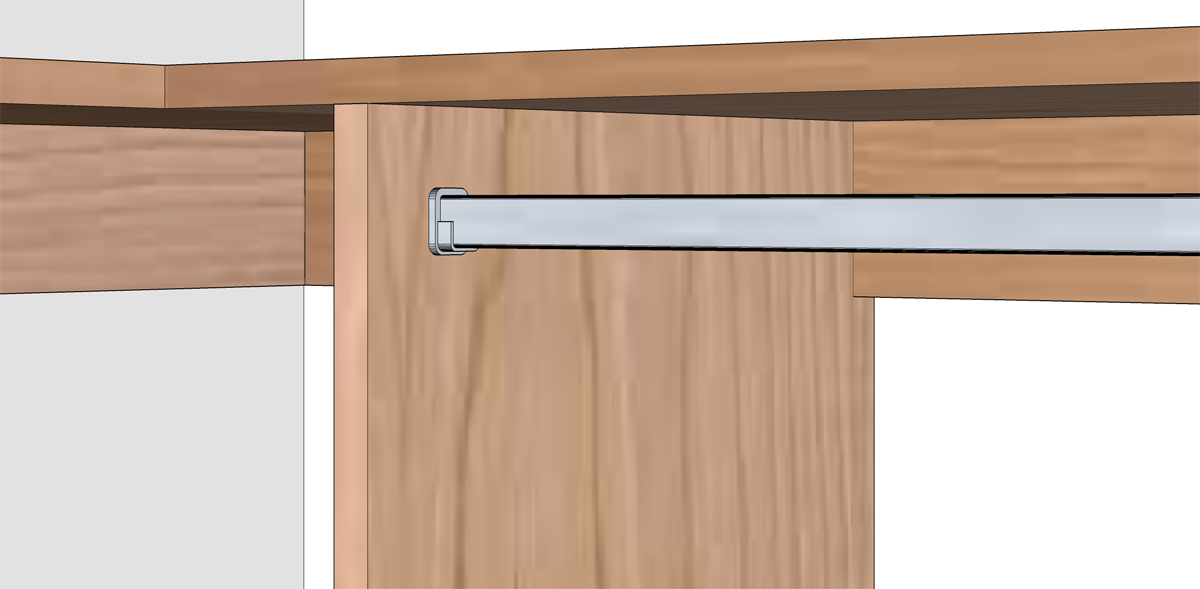
With the rod support in place you can now install the closet rod. Directions will depend on what rod you use but it's important that the top-center of the rod is about 12" away from the back wall and about 1-1/2" down from the top of the shelving unit top and that the rod is installed level.

Step 12: Install Shoe Shelves

To install the shoe shelves, pocket holes will be drilled on the underside of the right side to attach to the shelving unit. On the wall side screws will be drilled from the top down into the wall supports. Drill pilot holes and countersinks so the screws are flush with the top or you can simply nail the shelves in place. Pilot holes are a good idea to prevent splitting the wood.

Step 13: Install Adjustable Shelves

Push the shelf pins into the appropriate holes depending on how you'd like to space the shelves in the shelving unit. Then place the shelves on top of the pins. Once the paint dries you can fill up your closet again.

If you'd like to add a drawer or two see my instructions on how to build drawer boxes.


17 Ocak 2013 Perşembe

DIY Small Closet Organizer Plans

Free woodworking plans for a DIY small closet organizer for closets 3-5' wide.

If you're stuck with a small closet there's not much you can do other than make more efficient use of the space. This small closet organizer does just that. It increases the closet rod by 20% and more than quadruples the amount of shelf space compared to an original design of a single shelf and rod.

Lack of shelf space tends to be the reason closets get so cluttered in the first place. We tend to use closets for more than just clothes. Anything that we don't want to throw away yet don't want out in the open gets thrown in the closet where it tends to get forgotten. If you haven't seen your closet floor in ages because it's pilled high with bags, boxes and shoes, that's a clear indication you lack enough shelf area in your closet. This closet organizer design aims to fix that problem.

Dimensions

Use these plans as a guide and customize them to your needs. The plans should work well for reach in closets between 3' to 5' wide and 24" deep. If your closet is larger, see my Closet Organizer Plan for 5' - 8' closets. If this seems like too much work check out my Easy Small Closet Organizer Plans.

In this example we're using a 48" wide by 24" deep reach-in closet that has an 11" space between the left side wall and the door trim. Make any necessary adjustments to suit your closet. Here is the floor plan of the closet we'll be working in.


If you're closet doesn't have much space between the sidewall and the door trim you won't be able to include the extended lower shoe shelves. You can still include the shoe shelves but they will only be 15" deep like the other shelves.

What You'll Need

Materials

Tools

Cut List

  • (1) 48" x 24" 3/4" Plywood Top Shelf
  • (1) 82-1/2" x 15" 3/4" Plywood Main Divider
  • (1) 42 x 15" 3/4" Plywood Lower Cabinet Side
  • (1) 24-1/4" x 15" 3/4" Plywood Lower Cabinet Top
  • (4) 15" x 15" 3/4" Plywood Shelves
  • (3) 15" x 24" 3/4" Plywood Shoe Shelves
  • Assorted 1x4 boards for main supports
  • Assorted 1x2 or 1x3 lengths for shelf supports

Cut Plan

The size of your closet will most likely be different so double check the cut plan after you make the necessary adjustments to the component dimensions.

3/4" Plywood

The main parts of the closet organizer are cut from 3/4" hardwood veneer plywood. Two sheets where used for this plan, 1 full 4' x 8' sheet and one 2' x 4' quarter sheet. 


Some of the cutoffs can be used for the 2" shelf supports but you might find it easier to use 1x2 or 1x3 boards that match the species of plywood you selected instead. It will save time in making all those little cuts and edgebanding.

1x4 Boards

The 1x4 boards are used for the top support as well as the lower support. The species of wood should match the plywood you selected and be finished the same way. You'll need 2 8' boards. Cut plan is not included because it will depend on your closet dimensions.

1x2 or 1x3 Boards

There isn't enough scrap on the plywood to create enough supports for the sweater and shoe shelves on the left of the organizer. You may want to forego the plywood supports and just use boards instead to minimize the cuts in plywood which can be time consuming if you don't have a table saw. Using boards also means you won't have to edgeband the supports that will be visible.

If you're using boards for all the shelf supports you'll need 4 8' boards.

Step 1: Cut and Finish Parts

It's best to cut out all the parts and finish them before installing the closet organizer. Make any adjustments necessary to suit your closet size, cut out the parts, apply edgebanding to the edges that will be visible, sand smooth with 80 then 120 grit sand paper, finally either prime and paint them or stain and seal them.

Oil based paints and finishes are not a good idea for closets because they can out gas for a long time and make your clothes smell. Instead use low VOC water based paints or water based stain and a water based finish such as Minwax Water-Based Polycrylic.

Step 2: Prepare Your Closet

While your waiting for the closet organizer components to fully cure, get your closet ready for the new organizer.

Empty out the closet and store your clothes in a safe place. Carefully remove the old closet shelf, rod and other boards that were a part of that configuration.

Patch the walls with joint compound, sand and then prime and paint with a low VOC water based paint.

Step 3: Mark For Top Support

Use a level to find the highest point in the closet floor along the back wall. Houses can shift over time and the floors won't always be level. 

From the high point in the floor measure up 82-1/2" and draw a level line (in pencil) on the back wall, both side walls, and the front section where the shelves will be.


Please note that to make it easy to show the installation, some of the walls are not visible.

Step 4: Install Top Support

Measure and cut the 1x4 top support and screw it into the walls using 3-1/2" wood screws making sure to screw into the studs. The top of the board should align with the level line drawn in the previous step.

Install the supports in the order shown. Starting with the return wall, next the left side wall, the right side wall and finally the back wall. Check your stud locations on the right wall and cut that support long enough to be screwed into at least 2 studs, one in the corner, one towards the end.


Drive 2 screws at each stud location.

Step 5: Install Divider

Draw a plumb line using a level 15" from the left wall (the wall where the shelves will be.)


Prepare the divider by cutting a notch at the top to fit around the top support 1x4 and at the bottom to fit around the baseboards.

Drill 2 pocket holes at the top notch to be able to attach it to the top support.


Align the left side of the Divider with the plumb line and drive 2 screws through the top pocket holes. At the bottom use an L bracket to attach the divider to the floor, making sure it stays plumb.

Step 6: Install Lower Support

Draw a level line on the right side of the Divider, 42" up from the floor. Install the Lower Support 1x4 so the top is flush with the level line. Use 3-1/2" wood screws to secure the Lower Support into studs. Make sure that when you install the Lower Support you to not push the Main Divider out of plumb.


Secure the main divider to the end of the lower support using 2 1-1/2" wood screws. Drill pilot holes before driving the screws to prevent splitting.

Step 7: Assemble Lower Cabinet

The lower cabinet defines the bottom hanging area. It consists of the top and side and gets attached to the main divider.

Begin by drilling the necessary pocket holes in both pieces. In the Lower Cabinet Top there are 3 pocket holes on the side to attach to the main divider. In the Lower Cabinet Side there are 6 pocket holes. 3 on the top to attach to the Lower Cabinet Top, and 3 on the bottom to attach to the floor. You can also use an L-Bracket to attach the side to the floor instead.

After you drill the pocket holes, attach using the appropriate pocket screws as shown below.

Step 8: Install Lower Cabinet

Position the assembled Lower Cabinet over the Lower Support as shown. You'll need to cut a notch on the bottom of the Lower Cabinet Side to fit around your baseboards.

Make sure it's level and plumb all around and secure it to the Main Divider using pocket screws, to the Lower Support from the top and side using 1-1/2" wood screws that are countersunk (drill pilot holes to avoid splitting), and finally to the floor using pocket screws or L brackets.

Step 9: Install Top Shelf

Check to make sure the Top Shelf fits properly. Trim it to size if necessary then place it so it rests on the top supports.

Screw it in place using 1-1/2" wood screws that are predrilled and countersunk. Screw it down into the top supports as well as the top of the Main Divider.

Step 10: Install Closet Rods

Mount the Closet Rod Flanges, cut the pole to size using a hacksaw and mount them as shown.


The closet rods should be installed so that the top-center of the closet rod is 12" away from the back wall (not the back support) and 1-1/2" down from the shelf above it.

Step 11: Install Shelf Supports

Mark out level lines on the walls where the shelves will be installed. You can space the shelves whichever way works for you. A good starting point is about 12" spacing for sweater shelves and about 7" spacing for shoe shelves.

Use 3-1/2" wood screws driven into studs to install 2" strips of plywood (or 1x2 or 1x3 boards) at the marked lines to support the shelves as shown.

Step 12: Install the Shelves

Place the shelves on the shelve supports. Trim to size if necessary. Attach the shelves to the shelf supports by screwing down from the top with 1-1/2" wood screws that are pre-drilled and countersunk. On the side where the shelf meets the divider attach the shelf to the divider using pocket hole screws as shown.


For the lower shoe shelves that extend to the front wall, you'll need to mark and cut out an angle from the cabinet to behind the door molding.

Your closet organizer is now complete and ready for your clothes.


16 Ocak 2013 Çarşamba

DIY Closet Organizer Plans For 5' to 8' Closet

Free woodworking plans to build a custom closet organizer for wide reach-in closets. Can be customized to suit your needs and budget.

Over the years I've been redoing many of the closets in my home. The closets previously contained a single rod and shelf which didn't provide efficient use of space. These plans were inspired by the ClosetMaid Selectives 25 in. White Custom Closet Organizer which I have installed in a couple of closets.

I was planning on making some modifications to the closets and wanted to see what I could come up with if I built everything myself. Depending on the plywood I used I could either save significant money and or come up with a more attractive and better quality closet organizer.

Dimensions

Use these plans as a guide and customize the organizer to suit your needs. It should work well for reach-in closets 5' to 8' in length. You can modify the dimensions as you see fit.

The main cabinet dimensions as planned is 84" height, 25-1/4" width and 15" depth. The plans show it installed in a 6' wide 2' deep closet.

What You'll Need

Materials

Tools

Cut List

Depending on the size of your closet and any modifications you choose to make your cut list may be different.
  • (2) 84" x 15" 3/4 Plywood Sides
  • (6) 23-3/4" x 15" 3/4" Plywood Shelves (7 if your closet is 6' wide or less)
  • (1) 72" x 15" 3/4" Plywood Top Shelf
  • (2) 18-3/4" x 15" 3/4" Plywood Shoe Rack Shelves
  • (2) 23-3/4" x 2-5/8" 3/4" Plywood Nailers
  • (1) 23-3/4" x 3-1/2" 3/4" Plywood Top Nailer
  • (5) 15" x 3-1/2" 3/4" Plywood Side Brackets
  • (1) 27-1/4" x 3-1/2" 3/4" Plywood Top Shelf Support (Left)
  • (1) 18" x 3-1/2" 3/4" Plywood Top Shelf Support (Right)
  • (1) 23-1/2" x 5-1/4" 3/4" Plywood Drawer 1 Front
  • (2) 23-1/2" x 10" 3/4" Plywood Drawer 2 Fronts
  • (2) 12-3/4" x 4" 1/2" Plywood Drawer Box 1 Sides
  • (2) 1' 9-3/4" x 4" 1/2" Plywood Drawer Box 1 Front/Back
  • (4) 12-3/4" x 8-3/4" 1/2" Plywood Drawer Box 2 Sides
  • (4) 1' 9-3/4" x 8-3/4" 1/2" Plywood Drawer Box 2 Front/Back
  • (3) 12-1/8" x 22-1/8" 1/4" Plywood Drawer Box Bottoms

Cut Plan

Depending on the size of your closet and any modifications to the plans you choose to make your cut plan may need to be different. . Cut the back shelf supports, top shelf and shoe shelves a little longer than necessary and trim them to size during installation.

3/4" Plywood

The main components of the closet organizer are constructed of 2 4' x 8' sheets of 3/4" plywood which will provide for a very strong closet system. 

1/2" Plywood

The 1/2" plywood is used to construct the drawer boxes. You'll need 2 2' x 4' Sheet. A good choice is PureBond 1/4" Maple Plywood


1/4" Plywood

For the drawer bottoms you'll need 1 2' x 4' sheet of 1/4" plywood or tempered hardboard.

Finishing

You can choose to paint or stain/finish the plywood any way you'd like. If you're painting use low VOC primers and paints and if you're staining/finishing use water based stains and finishes to prevent your clothes from smelling. Oil based paints, stains and finishes tend to out gas for a long period of time and being in a confined space like a closet will concentrate the smell which will be absorbed in your clothing.

After you cut out all the pieces paint or stain/finish the components before assembly. It will make the installation go a lot quicker. Before finishing read the entire plan to understand which edges should be edgebanded before finishing.

Why Install A Closet Organizer?

If you live in an older home, the closets may not be as big as you'd like which means it's important to get as much out of the space as possible. The single rod and shelf configuration that existed in my closets wasn't cutting it. One of my closets was 6' wide which meant I had 6' of rod space and 6 linear feet of shelf space. By installing a closet organizer I preserved my rod space but doubled my shelf space.  It makes it easier to find what I'm looking for and helps keep my clothes from getting wrinkled when bunched close together.

Why Build When You can Buy?

There are many different closet organizers you can buy. The ClosetMaid Selectives Organizer I've installed are pretty nice and not too expensive but you only get a basic closet organizer system. Adding accessories to  make it more useful starts to bring up the price tag. Building my own will save some money.

The ClosetMaid Selectives organizer is constructed of 5/8" melamine coated particle board and I have installed some 5/8" melamine coated Closet Maid shelves as well. In one closet I am storing some heavier items and even with a span of only 26" there is noticeable deflection (bending). Building a closet organizer out of 3/4" sheet goods will make it sturdier and using something like PureBond hardwood veneer plywood can result in a more attractive closet that is also formaldehyde free.

Of course being able to customize the closet organizer is also a very attractive reason for building one yourself.

What Type Of Plywood To use?

At a minimum I would recommend 5/8" thick sheet goods but 3/4" is preferred and usually easier to find. Hardwood veneered plywood is stronger and a more attractive option. Since most of the organizer will be covered with clothes you don't need to get the more expensive cabinet grade plywood. The domestic plywood available at Home Depot, such as PureBond is a good choice. If you like the scent of cedar on your clothes and the purported insect and mildew resisting properties you might want to consider making the organizer out of 3/4" aromatic cedar plywood if you can find it. 3/4" MDF (medium density fiberboard) is a little cheaper if you plan on painting it. Melamine coated particle board is also affordable and you don't have to worry about finishing the panels. Some people like the melamine coating because it's easy to keep clean and saves some time by not having to worry about painting or finishing. Particle board isn't as strong and durable as MDF or better yet plywood. In the end you should get what your taste and budget allows for.

Step 1

Edgebanding should be applied to the front edge of both Side pieces and the bottom of the top Nailer. You can edgeband the bottom of the other two nailers if you'd like but chances are you'll never see those edges.

Having already cut and finished the plywood components it's time to start assembling the closet organizer cabinet. Lay one of the Side pieces on a flat work surface and attach the 3 nailers as shown using pocket holes and screws. The 3.5" nailer gets install flush with the top of the Side panel. The 2 2-5/8" nailers get installed at 14-3/4" and 41-1/4" from the bottom.

The nailers provide support to the cabinet as well as a structure to secure it to the wall.

You'll notice that a small notch is cut at the back/bottom of the side panel. This is to accommodate for the baseboard installed in the closet so that the organizer can sit flush against the back wall. The measurements for this cut will depend on the size of your baseboards. You don't have to be very precise and scribe the exact profile as this part will be hard to see.

Step 2

Install the 2 Fixed Shelves. The fronts of the shelves should be edgebanded before finishing. These shelves help give the organizer strength. They are installed on top of the 2 thin nailers that were installed in the previous step. Use pocket holes and screws to secure the Fixed Shelves to the organizer Side piece.

Step 3

Now attach the other Side piece securing it to the Nailers and Fixed Shelves using pocket holes and screws.

Step 4

With the main cabinet frame of the closet organizer assembled you can begin to start installing your closet organizer. 

Position the organizer in your closet where you'd like it depending on how much double and single rod area you prefer. This organizer doesn't work that well with sliding closet doors because most people will want to install this close to the center which will be blocked by the doors. Installing bi-fold closet doors will give you more access into your closet but you might also be able to get away with installing the organizer more towards one side if you don't need a lot of long hanging area for example.

Once you have the organizer positioned where you'd like make sure it's level and secure it to the wall by driving 3-1/2" wood screws through the nailers into the wall studs. 

Step 5

The side brackets help support the shelves and provide a secure surface to attach the closet rods.

Attach the Side Brackets that support the closet rods and shelves to the side walls. The plan calls for these brackets to be 15" long. Before you cut them out check the stud locations on your walls to see if you might need to make them a little longer to be able to screw them securely into 2 studs.

All the supports except one should be edge banded on the front and bottom. One of the supports which gets installed on the lower rod area of the double rod section (left in picture) should be edgebanded on three sides, top, bottom and front before finishing.

The back of the supports should be up against the back wall of the closet. On the double rod side two supports are installed at 42" and 84" above the floor. On the single rod side three nailers are installed. One for the closet rod at 84" above the floor and two at 7" and 14-3/4" above the floor for the shoe rack.

Make sure the supports are level and secure them into the studs using 3-1/2" wood screws.

Step 6

The Top Shelf Supports only need to be edgebanded along the bottom edge.

You should have cut these out a few inches longer than your plan had called for. Measure and trim them to size and screw them into the studs on the back wall using 3-1/2" wood screws making sure they're level.

Step 7

Cut the closet rod into three pieces of appropriate length for your installation. You'll need a hacksaw for metal rods.

I chose to design this closet organizer using chrome oval closet rods because I think the oval rods have a nicer appearance. The ClosetMaid organizer comes with adjustable closet rods which are convenient but because there are two pieces the rod is not smooth and hangers get hung up in the center. Custom cutting a rod to the exact size will eliminate that annoyance.

Drill holes for the pins on the closet rod flanges onto the appropriate spots on the side supports and organizer sides and secure them with screws. On the side supports the flange should be installed so the top-center of the rod should be 1-1/2" below the top of the side support and 12" from the back wall (not the back support).


On the cabinet side the flange should be installed so the top-center of the rod is 12" away from the back wall and 82-1/2" above the floor for the top rods and 40-1/2" above the floor for the lower rod. If everything else was installed accurately and level the rod should also be level but double check for level before screwing into the cabinet.

Once your closet rods are installed your organizer should look like this.

Step 8

Using a jig like the KREG Shelf Pin Drilling Jig drill holes for the adjustable shelf pins. Position the pins where you'd like and install the adjustable shelves. The shelves should be edgebanded on the front prior to finishing.

With the adjustable shelves installed trim the top shelf to length and place it on top of the organizer. Secure the top shelf in place with 1-1/2" wood screws into the top of the organizer sides and the supports around the edge. This will help stabilize the organizer cabinet and prevent the shelf from moving. Pre-drill and countersink the screws to prevent them from snagging any items placed on the shelf. A combination pilot hole and counter-sink bit set like the DEWALT DW2535 3 Piece #6, #8, and #10 Countersink Assortment comes in handy.

Attach the shelves for the shoe rack as shown, screwing from the top down into the side supports and using pocket hole screws to attach to the side of the cabinet. If you'd like to add more strength to these shelves if you anticipate people might try to stand on them to reach the top shelf for example, you can add additional bracing by installing a side bracket on the cabinet side.

Step 9

Drawers add convenience and a nicer appearance to the closet organizer but you can save a significant amount of money by omitting them and just installing more shelves. The cut plan accounts for extra shelves. One of the things I didn't like about the ClosetMaid Selectives closet organizer kit I purchased was that it didn't have a lot of shelves and necessitated purchasing either more shelves or drawers to make up for it which added to the cost.

If you choose to omit the drawers you'll save money by not having to buy the additional 1/2" and 1/4" plywood for the drawer box construction as well as the drawer slides and drawer pulls.  Instead you can add shelf pin holes and 2 adjustable shelves for added shoe storage.


One of the biggest cost benefits however comes from building your own drawers. For what it costs to buy just one of ClosetMaid's drawer kits you can build all three drawers for our DIY closet organizer.

There are 3 drawers in the plan. One 5-1/4" and two 10" drawers that get installed in the lower section of the closet organizer. You can choose any drawer pulls you'd like.

The drawer fronts should be edgebanded on all 4 sides.

Three drawer boxes are needed based on the design and drawer slides selected:
  • (1) 4" H x 1' 10-3/4" W x 12-3/4" D
  • (2) 8-3/4" H x 1' 10-3/4" W x 12-3/4" D
For instructions on construction please see my article on how to build drawer boxes.

Once the drawers are installed this is what your finished organizer should look like.

Reader Closets

Eric Bahor used my closet organizer plans to convert his home office into a walk in closet. He built it with his dad and it came out looking great! What do you think?